


The idea for a trip like this was born many years ago, long before I bought my 16-foot Zodiac in 2022. Eastport was, and still remains, my favorite place to dive in the North Atlantic. And the CanCat dive site, located in a small bay on the western side of Deer Island, where I dive with equal pleasure, lies just about a mile away from Harris Point Cabins,


About ten years ago, Andrew invited me on a two-week trip: a week in Canada, diving along the shores of Deer Island, followed by a move to Maine for a second week of diving in Eastport. By road, the trip from Deer Island to Eastport, including a short stop at U.S. Border Patrol, usually takes a bit over two hours. By sea, however, I calculated that crossing the strait between Deer Island and Eastport shouldn’t take more than five minutes.

driving to Eastport
There were years when a ferry ran between Eastport and Deer Island. But even then, one still had to fully check out of a motel in Canada and relocate to the United States… or the other way around. And that’s when the idea began to take shape: if traveling by motorboat proved workable, we could simply stay in Eastport and head out by boat to dive CanCat dive site, spending only minutes in transit instead of hours. And there was one more detail that made the idea almost irresistible: Harris Point Cabins has its own dock and standing on it, you could see the CanCat beach with the naked eye.

View of a Deer island from Eastport
Of course, the question of the legality of crossing the border inevitably comes up. As it turned out, there are specific rules that allow border crossing for water sports, including diving, provided that one does not step ashore in Canada, does not drop anchor, and does not tie the boat to a buoy located in the Canadian’s waters.

Collin O’Brien and I at Dawson Street dive site

A small island near Eastport’s shore
That naturally raises a delicate question: what happens in case of an unforeseen necessity, and what are the consequences if, for example, someone must go ashore? And as Collin found out, by calling Canada Border Services Agency, clear rules exist even for such situations. We learned, that if anchoring becomes necessary, all that is required is a phone call; to provide the boat’s registration number, along with the names and passport details of everyone on board. The same procedure applies in emergency situations, when going ashore becomes unavoidable.

View at the Old Steamship Pier dive site
Back in 2020, however, I didn’t yet know all these details, I only had learned that crossing the border for diving was possible. Therefore, when Matt came across a pontoon-style inflatable boat, in fairly good condition, I decided to buy it. My new acquisition needed a bit of modification: adding an outboard, installing a solid aluminum floor, and reinforcing/re-gluing D-rings.
I did consider going with a 40-hp, but decided that 25 hp would be enough. And, jumping slightly ahead, I can say this: with three people on board, full scuba gear for two, and two sets of cameras, it took us only three to four minutes, at a relaxed pace, to cross the distance between Eastport and Deer Island. We were moving slowly, partly because it was our first time, and because we had to maneuver around drifting patches of seaweed. I’m quite certain, that had I opened the throttle fully, even with 25HP we could have made the crossing in well under a minute.
Getting to Eastport
On 14th, Yuliia and I packed all our scuba gear, this time making sure not to forget the batteries for every camera we packed for this trip, hitched up the boat, and set off toward Eastport at around two in the afternoon.

Passing Rossport
Upon arriving we planned all to meet up for dinner, but Collin, who had gotten there a couple of hours earlier, let us know that a strong storm had knocked out power to almost the entire town and the only restaurant, that was still open, served nothing but alcoholic beverages. That, of course, didn’t trouble us in the slightest, cause, thanks to my wife, we had homemade belyashi, fresh vegetables, straight from the garden, chips, and beer. More than enough to end the day on a very pleasant note.

At the Happy Crab restaurant

A clever sign for a direction to a men’s room
Harris Point Cabins
Normally, when we come to Eastport in the summer, we stay at Harris Point Cabins. The place is located about a mile and a half from the Ols Steamship Pier dive site, the rooms are less expensive than at Motel East, and, which was especially important for this trip, the resort has its own dock.

Harris Point Cabin’s dock
The rooms, while slightly smaller than those at Motel East, are still perfectly comfortable for two and even for three occupants. In addition, the property has a large area, smartly following the circumference of the shoreline to accommodate RV parking, complete with water and electrical hookups.

Harris Point Cabin’s RV’s park
For all these reasons, I’ve always enjoyed staying here, not to mention again more reasonable nightly rate.
Diving Old Steamship Pier
Dive schedule for all three days was quite comfortable. On a first day low tide began around ten in the morning, which meant that we could start diving at eight. Our first dive was planned at Old Steamship Pier.

Atlantic ancula (Ancula gibbosa)
However, during my previous visits, nearly the entire area had been overtaken by massive kelp growth and I wasn’t sure we’d be able to reach the wall at all. Hence, even before getting in the water, Collin and I agreed on a backup plan: if Old Steamship Pier looked discouraging we would explore Far Reef, located in close proximity from OSP.

Flabellina verrucosa
That’s exactly how it turned out. Once we descended, it became clear that the kelp had spread across an even larger area, now covering the surfaces of the sinker logs, places that once hosted an incredible abundance of marine life.

Dead man’s fingers (Alcyonium digitatum)
Just a couple of years earlier, those submerged logs were teeming with nudibranchs, especially fuzzy onchidoris. There were so many of them, that I would often swim right past, stopping only to photograph the most striking individuals. Finding other species of nudibranchs on, under and around those logs was never a problem either. On one occasion, over the course of just two dives, we managed to document eleven different species. Nearly the entire wall was once carpeted with northern red anemones, dead man’s fingers, and, not uncommonly, sea strawberries and soft corals. Yes… there was a time.

Doto nudibranch (Doto formosa)
So, Collin and I decided not to linger. After about five minutes of swimming, we reached Far Reef, and the scene there was completely different. Unlike the wall, this rocky formation, located closer to the middle of the channel, is fully exposed to strong currents, giving kelp little to no chance to take hold on its ledges and crevices.
As a result, barely a minute after reaching the reef, I spotted Flabellina verrucosa, followed shortly by several Doto formosa, and then, about a minute later, my most desired nudibranch of all: Eubranchus tricolor.
Interestingly, in previous years, whether the water was colder or the salinity varied quite a bit, this species had been a true rarity. Now, however, it could be found almost everywhere, and in large numbers. I pointed one out to Collin and almost immediately he found several more tricolor specimens nearby.

Doto nudibranch (Doto formosa)

Painted balloon aeolis (Eubranchus tricolor)
The dive at Far Reef turned out to be far more interesting than if we stay at the wall. Still, there was one thing that bothered me. Compared to previous visits, the number of northern lamp shells on the reef had noticeably declined.

Northern Lamp Shell (Terebratulina septentrionalis)
There used to be plenty of them at this location and I would often take my time choosing either the largest one, or the one positioned at just the right angle. This time, however, there were significantly fewer. The shells themselves were smaller and appeared only in small, scattered clusters. Collin and I spent about forty-five minutes exploring the reef and then, satisfied with photo-harvest, made our way back to shore.

Northern Lamp Shell (Terebratulina septentrionalis)
Diving Dawson Street
After lunch and a short rest, we drove to the site of our next dive – Dawson Street. Collin’s great wish was to find and film Gene the Wolffish, who lives beneath a rock, at a depth of about fifty feet. For many years now, hundreds of divers, almost like pilgrims, have descended to visit the famous fish.
As I’ve mentioned before, in the book Fifty Places to Dive Before You Die, Gene is honored with a page of its own. Once, during a conversation with Johnathan Bird, the owner of Blue World TV, I was told that Jonathan, before buying a house on Dawson Street, decided to do a dive there first. And during that epic dive, he discovered this magnificent representative of the Anarhichadidae, discovery of which, I imagine, was very influential in decision to buy a house.
It’s worth noting that this dive, like so many before, began with great enthusiasm and high spirits. At that time, we had no idea that once we descended and reached the lair of the famous fish our mood would turn 180.
Collin was the first to locate the den. He waved his flashlight, and when I swam closer and looked inside, I saw that the lair was empty. My eyesight isn’t what it used to be, and although I dive with a mask fitted with magnifying lenses, it seemed to me that something resembling a piece of white rope was lying inside. I backed away from the rock and, for a brief moment, thought that someone used a rope to pull Gene out of his home and imprisoned him in an aquarium.
But a second later, the truth was unraveled. Collin reached inside and pulled out the decomposing skeleton of the fish. I can’t adequately describe how my mood collapsed in that instant. For so many years, we had been diving at this site just to visit our beloved friend, waive him “hello” and take a few pictures.

But now Gene was gone. And when we shared this sad news on Facebook, someone commented, that with Gene’s disappearance, an entire era had come to an end. And I think there is a great deal of truth in those words.

The Atlantic wolffish does have natural predators, especially when young and vulnerable. As adults, however, and Gene was certainly an adult, the main hunters, capable of preying on them, are seals. Perhaps that is why wolffish spend most of their lives in their dens, avoiding unpleasant encounters.

But no matter how well protected you are, or how deep your shelter lies, there is one relentless hunter that shows mercy to no one. The TIME, that ruthless executioner, always appears at the wrong moment, claiming what is due.
The typical lifespan of an Atlantic wolffish is about twenty years, more than enough time to make many friends among visiting divers. And considering that the first time I met Gene, already fully grown fish was sometime around 2010 or 2011, therefore, the moment of his passing feels, sadly, about right.
On this dive, I was carrying only my small video camera, having decided to leave my heavy photo rig on shore. As a result, I don’t have good pictures, just a few screenshots (posted above) that I pulled out of a short video of Gene’s remains.
On our way back, Collin, who primarily was using his camcorder, shot a beautiful video of a Sea raven.

Sea Raven. By Collin O’Brien
About fifty minutes later, we surfaced and shared the sad discovery with Yuliia and then called Jonathan Bird. And although we understood, rationally, that we were speaking of just a fish, but realizing how well Gene was known and beloved, made all of us feeling anything but light.
We packed up our gear and drove back to the hotel. That evening, over dinner, we all raised our glasses and wished Gene fair seas and eternal swimming. I hope, my friend, that in your next life, you won’t spend years hiding beneath a massive rock, but will swim freely, afraid of nothing, and add even more friends to thousands who never forget you.
Diving off a boat at Deer Island
As I mentioned earlier, in 2022, thanks to Matt Wills, I acquired my own 16-foot Zodiac. The aluminum floor added rigidity, the large storage box provided ample space for dive gear, and the 25-hp Yamaha Motor outboard delivered more than enough power to confidently reach nearby dive sites and make the return journey with ease.
On my previous visit, I had spoken with the hotel owners and received permission to keep the boat at their dock. By then, Yuliia had become comfortable operating the Zodiac, and for this particular journey, I truly couldn’t have asked for a better dive buddy than Collin O’Brien.
Thus … finally … all the stars aligned for the real test.

Collin and I at Eastport downtown’s boat launch

Yuliia – the best skipper in the world
That morning, the very first thing I did was walk down to the dock to check the condition of the water and was stunned by how smooth, quiet, and calm the ocean was. There wasn’t a single wave on the surface, not even a ripple. After breakfast, when we began preparing the boat for the crossing, a slight swell appeared, and the water no longer looked like a mirror, but in general the surface remained beautifully calm and peaceful.

The morning of the voyage
Collin and I put on our drysuits. Collin settled himself at the bow, resting his underwater camera on his knees, while Yuliia and I took our places at the stern. I started the engine, and we pushed off from the dock. The boat turned gently, and at the very low speed we headed toward CanCat Beach.

No matter how much I had tried to estimate the crossing time, I could never have imagined that even at a crawling speed, carefully maneuvering between small drifting islands of seaweed, it would take only three to three-and-a-half minutes to travel from Harris Point pier to CanCat Beach. In other words, in good weather, with a calm ocean and at full speed, this distance could easily be covered in less than a minute.

On a way to CanCat
Once we reached the beach, Collin put on his tank and slipped into the water. I handed him his camera and began gearing up myself. By the time Collin and I were ready to dive, Yuliia was finishing up her phone conversation with the Canada Border Services Agency, waiting to receive our identification number.

Collin at the CanCat beach

I’m getting ready for the dive
The dive itself was fairly ordinary. Aside from Eubranchus tricolor and a beautiful Doto coronata, nothing particularly special caught our eye. But that day, something far more important had already happened, something I had been waiting and preparing for a very long time. And even though we still had the return trip ahead of us, I was already genuinely happy that we had managed to reach the neighboring island on our own boat, without any complications or mishaps.

Doto coronata laying eggs

Eubranchus tricolor

Northern Red Anemone (Urticina felina)
A here is a note for the future trips;
…to set aside an extra 20–40 minutes for inevitable organizational delays: loading gear, rechecking that nothing was left behind, making a few back-and-forth trips for forgotten items, waiting on phone calls, and similar small, but time-consuming details.

Orange footed cucumber (Cucumaria frondosa)
I inflated my gear, tied it up to the Zodiac and climbed aboard. I took Collin’s camera first, then, with Collin’s help, hauled my dive equipment in, followed by Collin’s BCD and tank. Once Collin climbed back into the boat, we were ready for the ride home. And no matter how much I tried to stretch the moment, enjoying sound of the parting waives, pushed gently by the boat’s hull, we found ourselves back at Harris Point pier remarkably quickly.

Getting back on a boat
Today, looking back, I ask myself what I could have done differently, to make that boat trip easier or better. And honestly, almost nothing. Perhaps we could have departed from Harris Point twenty or thirty minutes earlier, giving ourselves a bit more time for dive preparation and the phone call to the Canada Border Services Agency.
Otherwise, considering that this was our maiden voyage to Canada by boat, everything unfolded exactly as I had dreamed it would: excellent weather, a calm ocean, an easy crossing, a good dive, and wonderful company to share it with.

My wife and I on a way to CanCat
So that’s it, a new route was laid out and tested. It worked, and a boat can now be used to save a considerable amount of time, avoiding many of the inconveniences associated with long drives, repacking gear, and moving from one motel to another.
Yes, the boat is small and can, somewhat comfortably, accommodate no more than two divers with full gear and a skipper. But with proper planning, given the short distance between two shores and negligible crossing time, it’s entirely feasible to bring more than two divers, this particular Zodiac (MilPro) was designed to carry ten navy seals in full dive and military gear … hooyah …
Or… perhaps I should ponder over Shakespearean question: to get a bigger boat, or not? 🙂

Doto formosa
But in all seriousness, I’m quite certain that for a long time I’ll stick with what I already have. It’s been proven to work well, for short distances, and even that alone is far more than I ever expected. Thank you, Yuliia and Collin for being there with me and helping this long-held dream finally come true.

Acadian hermit crab (Pagurus acadianus)
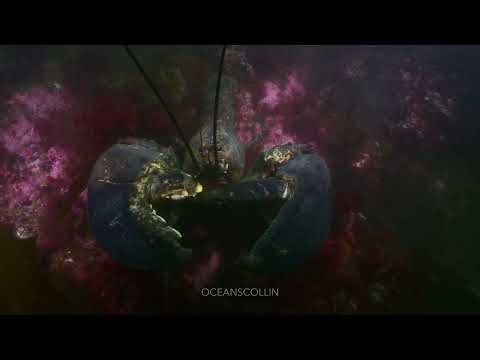
A giant lobster at Deer Island. By Collin O’Brien

This film would never have happened without my wife’s relentless dedication
to recording everything that was happening around her.
Thank you, honey.
Going back to Dawson
The second dive of the day was planned at Dawson Street. After we shared the news of the deceased fish with others, Andrew J. Martinez suggested trying to find another specimen, the one that had often been spotted just a few feet away from Gene’s den. It sounded like a great plan and I told myself that in case of successful “hunt”, I would count, at least in my mind, such a providential outcome as Gene’s resurrection. Collin and I were more than happy to give it a try.
We descended quickly and, without much delay, found Gene’s now-empty lair. This time, I had brought my larger camera, but of the remains we had seen just yesterday, only a small fragment of the spine was found.

Without wasting time, and following Andy’s directions, we carefully explored nearby hideouts, crevasses and burrows, hoping they might be occupied by another wolffish. Unfortunately, our efforts were fruitless. After about fifteen minutes of intensive searching, we headed toward the base of a cliff and, pushing our way through long strands of kelp, soon found ourselves back at the shore.

Concise cuthona (Cuthonella concinna)
All in all, the dive lasted fifty minutes. Too bad we did not find yet a worthy successor to Gene’s legacy. But the confidence remained high, after all, as the saying goes, a sacred place never stays empty, we just need to wait a little.
Conclusion
And although discovering Gene’s remains cast a noticeable shadow over our mood, I consider this trip as an epic one. After all, more than ten years had passed between the moment the idea was born and its eventual realization, and it was deeply satisfying to know that this long-held dream had finally come true.

White Atlantic cadlina (Cadlina laevis)
Despite the fact that having a boat saved us at least four hours of driving time (that is getting to CanCat dive site and back, not to mention fuel costs), I don’t think I will be hauling my boat along on every trip to Eastport… though I certainly will try :)

Flabellina verrucosa
The reality is that in order to avoid calling and dealing with Canadian immigration authorities, someone must remain on the boat at all times, actively operating it, without dropping anchor or tying off to a buoy. On top of that, climbing back into a small boat after a dive isn’t equally easy or comfortable for everyone, age has a way of reminding us of itself. And for many divers, especially those planning to spend a full week on the island, it’s simply easier to drive to the shore, gear up calmly, and step into the water without any extra logistics.

Fuzzy Onchidoris (Onchidoris muricata)
And yet, there is a tested, working option, one that allows us to quickly reach a neighboring island and dive along its shores. I truly hope this won’t be the only trip of its kind, and that many more great and successful journeys still lie ahead, aboard a boat that may be small, yet fully capable of making such trips a reality.

Bushy-backed Nudibranch (Dendronotus frondosus)

Sea Scallop (Placopecten magellanicus)
My heartfelt thanks go to Yuliia and Collin O’Brien for their support and help in making my dream to come true – you, guys, rock.
Safe diving and great discoveries to all
Photo Equipment

EOS Canon 5DS R
I’m using Canon 100mm lens for my macro shots.
Camera settings;
Speed – /125 – /200
f – 13-22
ISO – 100-250

Ikelite Housings for DSLRs
We both using Ikelite housings for DSLRs with dual handles. Ikelite housings proven to be extremely reliable, easy to use and maintain.

Ikelite DS 161
We both using 2 Ikelite DS 161. Dual strobes allow better light management and creation of disagreeable effect. DS 161 Strobes are perfectly matching with the Ikelite housings, allowing to use TTL. Plus, DS 161 has a Video Light, which can also used for video shooting or an emergency light. Strobes are in constant use for at least 7 years and proven to be very reliable.

Sola Photo 1200
Sola Photo 1200 has both, White and Red light output options. We use the Red light to photograph skittish animals – shrimps, fish, etc. 1200 lumens is plenty to assist the camera for proper focusing. We also use rapid switching between White and Red light to attract each other attention.

Leave A Comment