


Our previous excursion to Peirce Island had taken place just a few days earlier, rewarding us with great visibility and an abundance of nudibranchs. Riding that momentum, we returned for diving UNH Pier in New Castle, a familiar and much-loved site where I once captured one of my favorite underwater photographs.

UNH Pier. New Castle, NH
As with all diving in New Hampshire, timing was dictated by the tides. That Friday, the entry window lined up perfectly at three in the afternoon, which meant no ungodly wake-up hours and no traffic slowdowns. By two o’clock we had all arrived at the parking lot near the Judd Gregg Marine Research Center, where we ran into two divers just finishing their dives. Their reports only raised our expectations: excellent visibility and, as a bonus, a sighting of a Fifteen-scale worm.

Fifteen-scale worm (Harmothoe imbricata)
While gearing up, Andrea announced her personal mission for the dive, she wanted to find a Shag-rug aeolis. At 2:58 p.m., we slipped into the water and began our exploration.
Diving
The visibility truly was spectacular. From a distance of twenty to twenty-five feet, the bridge pillars stood out clearly in the water. There was, however, a silver lining to such clarity: Andrea’s dive computer registered the water temperature at 37°F (3°C). And yes, waist-deep in the water was all it took for me to realize my heated vest would be switched on immediately.
Reaching the nearest abutment, Feng signaled me over with his flashlight and pointed out a fifteen-scale worm, slowly crawling across a rock. I took a few photos and then shifted my attention to my favorite subjects … nudibranchs

Fifteen-scale worm (Harmothoe imbricata)
On previous dives at this location, around the second and third bridge sections, there had been several ropes arranged in two tiers around four bridge supports, forming something like an enclosure. Plates were attached to these ropes, likely installed by the institute for research in marine biology, oceanography, and ocean engineering. Those ropes had been the backdrop for some of my favorite photographs.

Flabellina bostoniesa (2022.11.11)

Flabellina bostoniesa (2022.11.11)
This time, though, Feng had warned me before the dive that the ropes were gone or had been removed. Only on the outer side of the pier could we find a couple of remaining lines. On one of them, Feng managed to spot a practically microscopic Orange-tip cuthona. How he managed to distinguish it among the hanging chaos of hydroids and weeds, perfectly camouflaged against the background, is beyond me. But he did. And after six or seven attempts, I managed to get a more-or-less decent photograph.

Orange-tip cuthona (Tenellia gymnota)
Although a bit later I found a Flabellina verrucosa, the main prize of the dive belonged to Andrea, who ultimately found her long-awaited Shag-rug. As it turned out, we found so many of them that when we finally exited the water and Andrea was sharing impressions with Yuliia, she accidentally coined a new expression. It had been, she said, a nudiful dive.

Flabellina verrucosa
Naturally, recalling a famous song, we started humming that it was the most nudiful dive of the year.

Flabellina verrucosa
I won’t claim that this was objectively true. If we count sheer numbers of nudibranch species, the previous dive might have been richer. But if we focus on one specific nudi, the Shag-rug, then this dive was absolutely one of the most nudiful dives of the year… at least of 2026 and as of today.

Shag-rug aeolis (Aeolidia papillosa)
At one point, Andrea pointed out a baby Shag-rug almost completely hidden beneath a sunken branch of a tree or piece of weed. I carefully tried to lift it to get a better view and improve our photo opportunities. But as soon as I started moving it, Andrea urgently tried to stop me, signaling that the branch itself was covered in multiple Shag-rugs. And indeed, there were more nudis on that piece of weed than one could shake a stick at.

Shag-rug aeolis (Aeolidia papillosa)
Thankfully, there was just enough current to quickly clear the sediment I had stirred up. While waiting for the dust to settle, we spotted even more Shag-rugs just a few feet away.

Shag-rug consuming Clonal plumose anemone
Seventy minutes into the dive, despite the heated vest, my body was slowly losing its battle with the bone-piercing cold. I signaled to Feng that I was heading toward shore. About ten minutes later, Andrea and Feng surfaced as well. Once our fingers thawed and we managed to pack our gear, we unanimously agreed to end the day at a Thai restaurant, located just a short walk from the Peirce Island parking lot.

Hermit crab
Conclusion
It was an awesome day, and even the numbing ocean temperature couldn’t cast a shadow over what was truly a most nudiful dive of the year. Great visibility, fantastic finds, and wonderful company, everything on that day aligned just right. Now, I’m already looking forward to a full-blown Verrillifest, that hopefully is coming soon.
Safe diving and great discoveries to all.

Peirce island at night
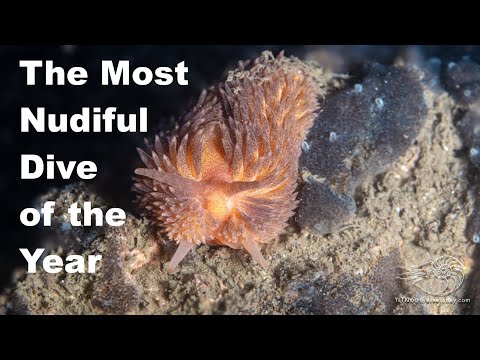
“The most Nudiful Dive of the year”. With help of Chat GPT and Suno AI
Photo Equipment

EOS Canon 5DS R
I’m using Canon 100mm lens for my macro shots.
Camera settings;
Speed – /125 – /200
f – 13-22
ISO – 100-250

Ikelite Housings for DSLRs
We both using Ikelite housings for DSLRs with dual handles. Ikelite housings proven to be extremely reliable, easy to use and maintain.

Ikelite DS 161
We both using 2 Ikelite DS 161. Dual strobes allow better light management and creation of disagreeable effect. DS 161 Strobes are perfectly matching with the Ikelite housings, allowing to use TTL. Plus, DS 161 has a Video Light, which can also used for video shooting or an emergency light. Strobes are in constant use for at least 7 years and proven to be very reliable.

Sola Photo 1200
Sola Photo 1200 has both, White and Red light output options. We use the Red light to photograph skittish animals – shrimps, fish, etc. 1200 lumens is plenty to assist the camera for proper focusing. We also use rapid switching between White and Red light to attract each other attention.

Leave A Comment